
By: Daniel Woytowich

Image courtesy of Warwick Business Schools
Most marketing teams now have access to AI tools; far fewer have the skills to get real value out of them. In a Gartner survey reported by MediaPost, 56% of marketers ranked skills shortfalls as the biggest barrier to adopting generative AI, ahead of security threats (47%) and integration with existing technology (43%). However, “skills gap” is a vague diagnosis, and vague diagnoses lead to vague fixes, usually a lunch-and-learn and a shared login. My argument is that the gap rarely sits where teams go looking for it. Writing the prompt is the easy part; the hard part is everything that happens before and after it.
The Pressure Behind the Gap
The skills question matters more right now because budgets aren’t growing. Gartner’s 2025 CMO Spend Survey of 402 marketing leaders found budgets flat at 7.7% of company revenue, with 59% saying they lack the budget to carry out their strategy. Moreover, 39% plan to cut labour spending, 39% plan to cut agency budgets, and 22% say generative AI has already let them rely less on outside agencies for creativity and strategy.
This means that teams are being asked to bring more work in-house, with the same headcount or fewer, and AI is expected to cover the difference. Thus, the skills gap is really a capacity problem wearing a training badge.
Where Teams Point AI Today
According to the same Gartner data reported by MediaPost, the most common uses of generative AI in marketing are content production (58%), social media copy (52%), and ad copy (45%). The top benefits marketers reported were faster speed to market (56%) and improved productivity (53%).
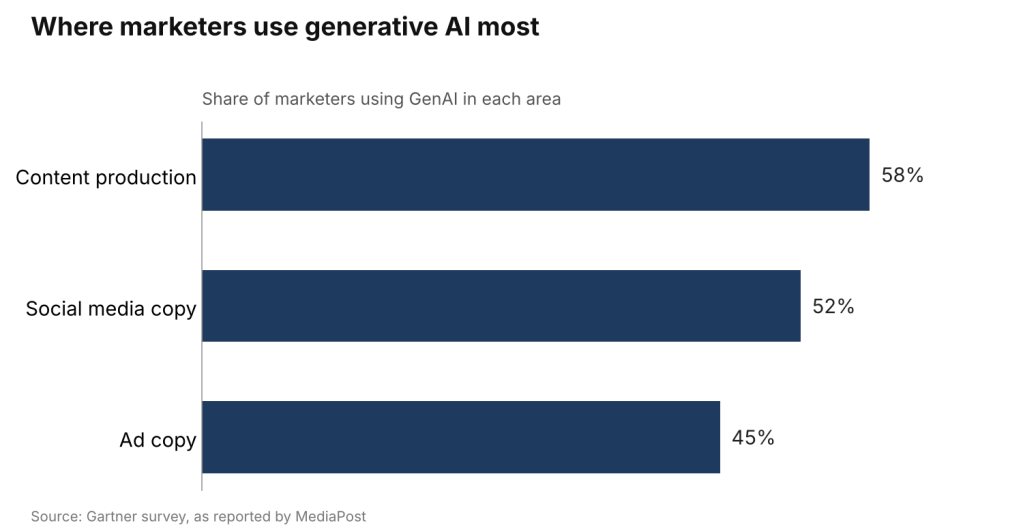
In other words, most teams aim AI squarely at production, the part of the job that was already the most visible. That is a reasonable place to start. However, production is also the step where the tool does the most work and the person does the least, so it’s the step where a skills gap is easiest to hide.
The Three Places the Gap Actually Sits
1. Before the prompt: the brief. AI output is only as good as the context it receives — the audience, the objective, the positioning, and the constraints. A team member who can’t write a sharp creative brief won’t write a sharp prompt either; the tool will simply produce the weak brief faster.
2. After the prompt: the edit. Someone still has to decide whether the output is accurate and on brand, and whether it’s worth publishing at all. That is editorial judgment — fact-checking, brand voice, and reputational risk. Faster drafts with no stronger editing just means more mediocre content, shipped sooner, and the internet is not exactly running low on that.
3. After publishing: the measurement. For most marketing managers, the real job is proving marketing’s impact. Gartner found that 49% of marketing leaders reported time savings from generative AI and 40% reported cost savings. However, time saved only counts if someone can show where it went. If nobody on the team can connect AI-assisted output to results, those efficiency gains will quietly disappear in the next budget meeting.
What This Means for a Marketing Manager
If you manage a team, the practical shift is small but important. First, audit tasks, not tools: list what your team produces in a typical week and mark every point where a human has to make a judgment call. Second, train for briefing and editing before you train for prompting, since those skills carry over to whichever tool your company licenses next year. Finally, when you hire, look for people who can explain why an output is wrong, rather than people who can only produce it quickly.
Conclusion
In conclusion, closing the AI skills gap has less to do with knowing which buttons to press and more to do with the skills marketing has always depended on — clear briefs, careful editing, and honest measurement. The tools will change every quarter, but the judgment is what stays with your team.
Curious how I think about marketing, leadership, and the work behind the results? Learn more about me or get in touch.
Sources
MediaPost. (2023, July 20). GAI skill gap is biggest barrier to entry for marketers, Gartner finds. https://www.mediapost.com/publications/article/387408/gai-skill-gap-is-biggest-barrier-to-entry-for-mark.html.
Gartner. (2025). Gartner 2025 CMO Spend Survey reveals marketing budgets have flatlined at seven percent of overall company revenue [Press release]. https://www.gartner.com/en/newsroom/press-releases/2025-05-12-gartner-2025-cmo-spend-survey-reveals-marketing-budgets-have-flatlined-at-seven-percent-of-overall-company-revenue.


Leave a Reply