By: Daniel Woytowich · November 4, 2026

Image courtesy of Tom Fisk on Pexels
When the budget stays flat and the expectations keep climbing, most marketing managers are left with three realistic options: train the team they already have, pay an outside provider, or hire a junior. Each tends to be sold as the answer. I’d argue they actually buy three different things — upskilling buys judgment, outsourcing buys flexibility, and a junior hire buys recurring capacity — so the real question is which kind of work you need more of.
Why Is a Flat Marketing Budget a Problem?
A flat budget is a problem because the expectations on marketing keep growing while the money stays put. My last post on the AI skills gap covered Gartner’s finding that marketing budgets have stalled at 7.7% of company revenue, with 59% of marketing leaders saying they can’t afford to execute their strategy.
That post looked at where the skills gap sits. This one looks at where to put your money once you know.
Should You Upskill Your Marketing Team?
Yes, if the work you’re short on depends on judgment and brand knowledge. Training your current people keeps that knowledge in-house — the brand, the customers, and the unwritten internal dynamics — and it doubles as a retention tool.
That second benefit matters more than it once did. LinkedIn’s 2025 Workplace Learning Report found that 88% of organizations worry about keeping their employees, and that every company it labelled a “career development champion” saw positive business results.
The catch is that upskilling costs time before it saves any. The same report named insufficient manager support as the biggest barrier to career development (50%). In practice, the plan often depends on the person with the least free time: you.
Best for: judgment-heavy work that needs to stay close to the brand, e.g. briefing, editing, and measurement.
When Should You Outsource Marketing Work?
Outsource when the work is spiky or needs a specialist your team doesn’t have. Agencies and freelancers provide that expertise when you need it, and you can stop paying when the campaign wraps.
Notably, brands with their own in-house teams haven’t abandoned outside help. The Association of National Advertisers’ 2023 in-house agency report found that 82% of members now run an in-house agency, up from 42% in 2008, yet 92% of them still use outside agencies, mostly for added capacity or skills their team doesn’t have.
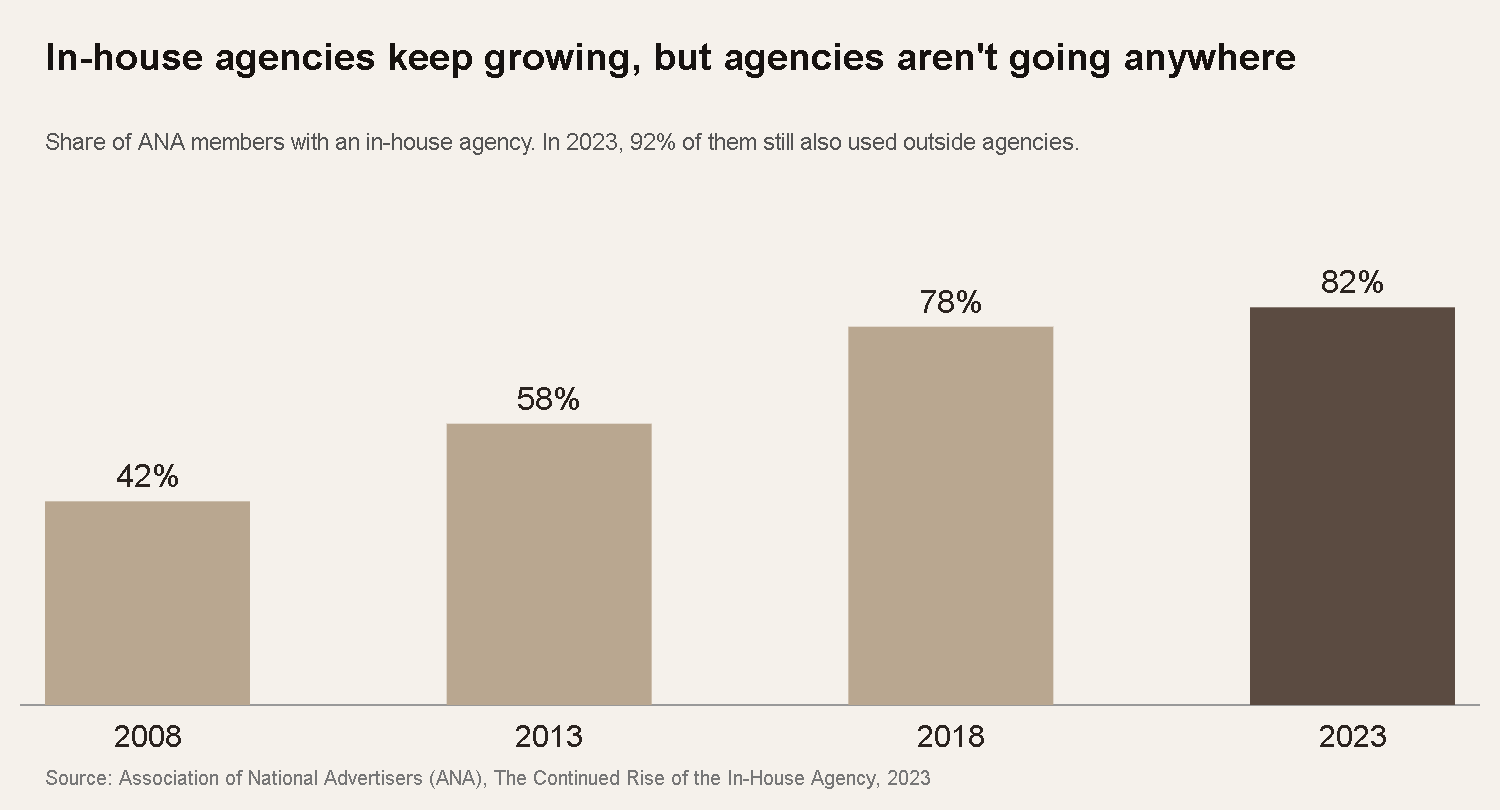
This means that outsourcing works better as a pressure valve than as a replacement. The trade-off is that the knowledge leaves when the contract ends. Every handoff also needs a brief, and if your team has trouble writing one, you’ll be paying an agency to guess.
Best for: spiky or specialist work, e.g. a campaign launch, video production, or a one-off research project.
Is Hiring a Junior Marketer Worth It?
It is when the work is steady and repeatable, because a junior hire is the only one of the three options that adds permanent capacity. The hiring process itself usually isn’t the costly part: SHRM’s 2025 Recruiting Benchmarking data put the median cost per hire for non-executive roles at roughly US$1,200, with positions typically taking about six weeks to fill.
The bigger expense comes after the offer — salary, onboarding, and the manager hours spent turning a promising hire into a productive one. Thus, a junior hire pays off when the work is predictable enough for someone to learn it once and keep doing it.
Best for: steady, repeatable work, e.g. weekly social content, reporting, and campaign coordination.
How Do the Three Options Compare?
Each option trades a different cost for a different benefit. Upskilling costs manager time, outsourcing costs higher rates and lost knowledge, and a junior hire costs salary and training.
| Option | What it buys | Main cost | Best for |
|---|---|---|---|
| Upskill | Judgment that stays in-house | Manager time, up front | Briefing, editing, measurement |
| Outsource | Flexibility and specialists | Higher rates; knowledge leaves | Spiky or specialist projects |
| Hire junior | Permanent, recurring capacity | Salary plus training time | Steady, repeatable work |
Should You Upskill, Outsource, or Hire Junior?
For most teams, the answer is a mix: upskill for the judgment work, outsource the peaks, and hire for the work that never stops coming. The deciding factor is the kind of work you’re short on, rather than which option looks cheapest on paper.
To be transparent, I am a student who would very much like to be someone’s junior hire, so feel free to apply a small bias discount to this section.
From my experience managing sales and marketing teams, though, the best option is to upskill first, then hire second. Upskilling first keeps your existing team sharp; for marketing, a well-trained and highly skilled team can mean the difference between breaking even, and making a profit. However, you should never downplay the importance of junior hires. Junior hires can be excellent assets — especially in peak seasons or industries with high turnover — provide new perspectives to optimize your business, and most importantly be an avenue to further upskill your existing team through training and mentoring. The result? A team that gets stronger with every person you add, because each new hire becomes a reason for your existing people to teach, sharpen, and grow.

Therefore, the most useful thing a manager can do before the next budget meeting is sort the team’s workload into those three buckets. That exercise will tell you more than any vendor pitch.
Conclusion
In conclusion, a flat budget doesn’t have to mean a flat year. Upskilling, outsourcing, and hiring junior each solve a different problem, and the teams that get more out of the same money are the ones that stop asking which option wins and start asking which work each one fits. The budget may not grow, but the return on it still can.
If you’re working through this trade-off on your own team, I’d like to hear how you’re approaching it. Leave a comment or get in touch with me, and let’s talk about it.
Daniel Woytowich is a fourth-year BBA student at the Schulich School of Business, heading to law school, who writes about marketing, leadership, and the work behind the results. More about Daniel.
Sources
Association of National Advertisers. (2023, May 2). In-house agencies no longer a trend — they’re here to stay: ANA report. https://ana.net/content/show/id/79185
Brazier, J. (2025, March 25). LinkedIn: Provide employees with career and skills development or run the risk of attrition. UNLEASH. https://www.unleash.ai/skills-development/linkedin-provide-employees-with-career-and-skills-development-or-run-the-risk-of-attrition/
SHRM. (2025). 2025 recruiting benchmarking. https://www.shrm.org/topics-tools/research/2025-recruiting-benchmarking


Leave a Reply